Nothing to Copy
Mike "Rooftop" Escamilla invented ten tricks by accident. Bun B knows exactly how that happens.
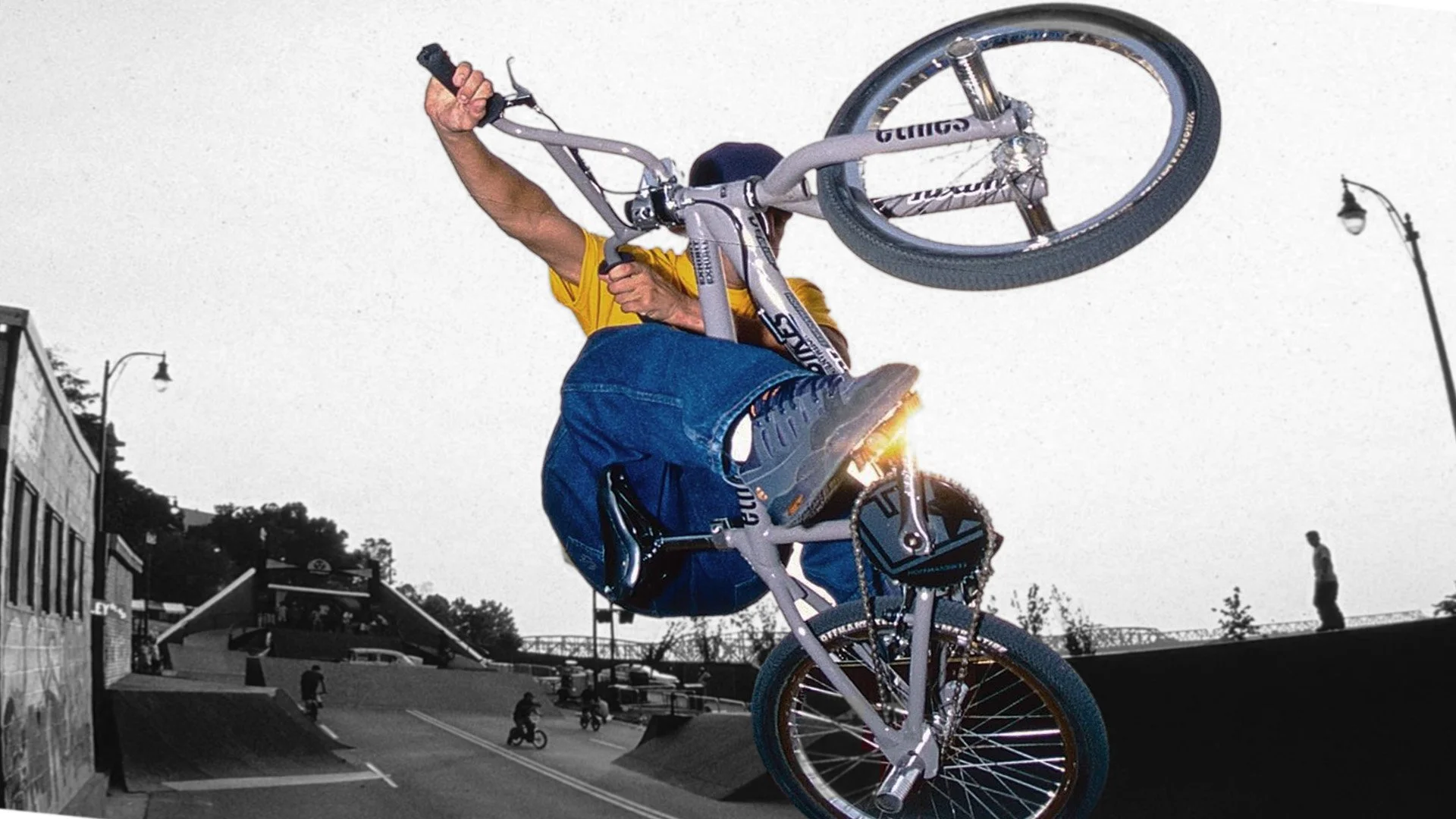
Mike Escamilla was fourteen when a filmmaker spotted him at the local jumps.
The filmmaker was Dave Parrick. The video was Dirty Deeds, a 1994 Trash Video release that BMX kids wore out on VHS. Mike met him every Saturday to film. When the tape came out, the kid from La Habra had the last part. The finale. The slot you give the rider you want everybody talking about in the parking lot.
He had no idea what he'd done.
"I invented, like, 10 tricks in that part, but I had no idea," he said on this week's Unglossy. "I'd see a picture of someone doing a version of something. I was like, oh, they must all be doing this."
They weren't. Nobody was. He was working from a photo in a magazine that showed up every couple of months, and maybe one video a year. He filled in the gaps with guesses. The guesses were new.
The beauty of not knowing
Most people would call that a disadvantage. Mike calls it the reason the era was good.
"That's sort of the beauty of not having the internet," he said. "You aren't bound by what other people are doing."
By the late nineties he made it a rule. "I almost stopped watching other pros' video parts because I didn't wanna be influenced on what was cool at the time."
Read that again. A professional athlete at the top of his sport, choosing not to study the competition. Every business book on the shelf says the opposite. Know the market. Benchmark. Watch what's working.
Mike's point is that watching what's working is how you end up doing what's working. Which is to say, what already exists.
His terrain helped. Southern California didn't hand him a lot of ramps. It handed him cement ditches and empty pools. "You'd see someone do something on a ramp, and you're like, well, it doesn't work for the ditch, but this way does," he said. "And people are blown away. And you're like, that's just how it translated."
Mat Hoffman saw it early. Hoffman Bikes signed him in 1995, and the company's own history of the relationship credits him with forging original lines instead of copying the playbook. Hoffman built prototype frames around the way he rode.
Port Arthur had the same problem
Bun B had the same story ready, from the other side of culture.
"UGK doesn't sound like KRS-One, and KRS-One doesn't sound like Too $hort, because, again, there was no internet," he said. "You knew you wanted to rap, but you end up making up your own version of it, because you're just isolated and doing your own thing. There was no influence to say, nah, the drums are supposed to sound like this."
UGK formed in Port Arthur, Texas, in 1987. A refinery town on the Gulf Coast, a long way from the Bronx and a long way from Oakland, with no rap infrastructure to speak of. What Pimp C and Bun built instead couldn't have come from a playbook. 808s, church organs, bluesy textures, thick soul, and enough slang and twang that the rest of the industry needed years to catch up. By Ridin' Dirty in 1996, it didn't sound like anywhere else on the map. Because it wasn't made anywhere else on the map.
Same mechanism as the ditch. Limited inputs. A picture of the thing instead of the thing. The gap between what you saw and what you had to work with is exactly where the new stuff came from.
Sledge put the bow on it. "It's not until it becomes prevalent in the space that you realize, oh, damn. I didn't know that nobody was doing it like this."
Then the gap closed
Here's the other side, and Mike doesn't sugarcoat it.
A video part used to take him about a year to film. "Then I could kinda have the juice off that for my career for a year or two after that," he said. Distribution was slow, so a trick stayed yours for a while.
Not anymore. "As soon as you know something is possible, some kid in Ohio will do it the next day... And then they're posting it just on their Instagram. So what does that do to the value of what you're doing?"
That's not a knock on talent. Mike is clear that today's riders are doing things he never could. It's a knock on what happens when everyone can see everything, instantly, forever.
Kyle Chayka named the condition in his 2024 book Filterworld: How Algorithms Flattened Culture. His argument: the recommendation feeds that now decide most of what we see and hear promise personalization and deliver sameness. Same cafés. Same apartments. Same songs. Same tricks, if you ride.
Mike's version is blunter. "Everybody has a voice now. And just because people have a voice doesn't mean they should be talking." He knows how that lands. He said it anyway. "I might get heat for this, but gatekeeping isn't really that bad."
You don't have to agree with him to see what's underneath. The old gatekeepers were slow, and slow was a kind of protection. It gave a new idea time to be yours before it became everyone's.
What to do with that
Nobody at the table wants to go back to one magazine every two months. The internet made room for riders and rappers who never would have gotten a shot.
But the Dirty Deeds story was never really about technology. It's about inputs. Mike made original work because he had fewer references. Later, he made original work because he chose fewer references. The ditch forced it first. Then he forced it himself.
That move is available to anyone. A brand, a band, a rider. Stop studying the feed for a season. Work from the terrain you actually have. Take the one blurry picture and guess.
Some of the guesses will be wrong. A couple of them will be the last part in the video.
Mike is 49 now. He still gets hyped on tricks he learned thirty-five years ago. That's what happens when the trick was yours to begin with.
Mike "Rooftop" Escamilla still holds the Guinness World Records for the longest BMX backflip (62 ft 2 in) and the longest BMX 360 (50 ft 6 in), both set off the mega ramp at X Games 11 in 2005. Follow him at @mikeescamilla.
Hear the full conversation on Unglossy with Bun B, Jeffrey Sledge, and Tom Frank. Produced and distributed by SAVAGE.